
3 key features to keep in mind when installing a fan convector
As low temperature heating systems are becoming the norm, there is an increasing demand for suitable emitters. If the system temperature drops below 45°C, a fan coil unit can be a great match. However, when installing fan convectors, there are 3 essential features to keep in mind. Our experts are happy to elaborate to ensure the best possible use and highest efficiency.
- Insights
- Fan Convectors
- Low temperature heating
- Heat pumps
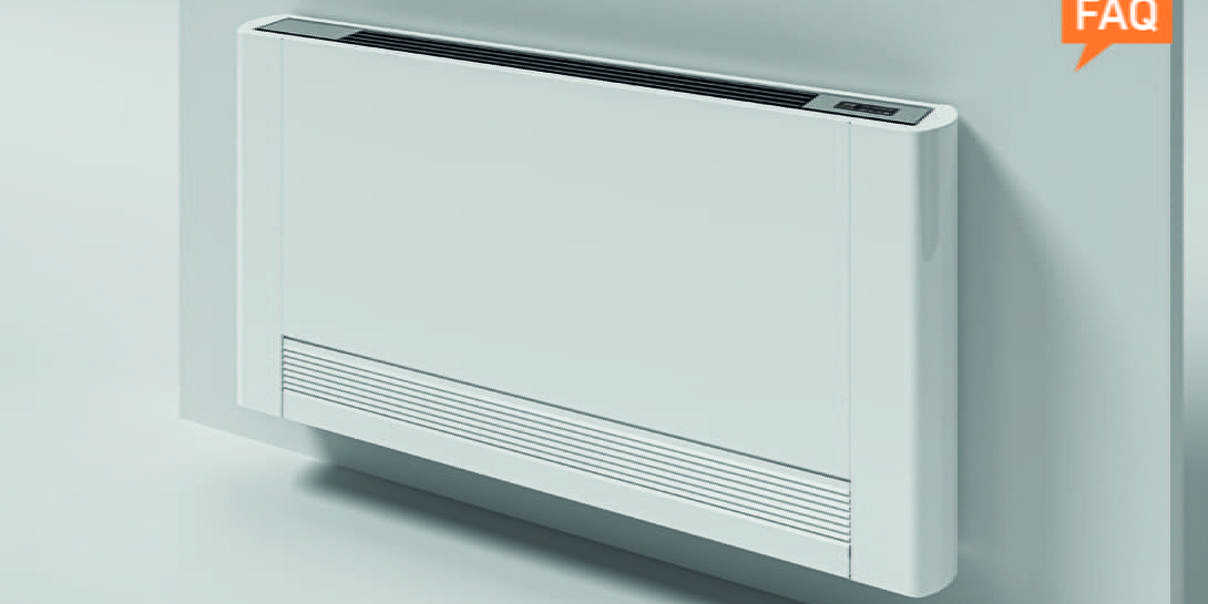
1. Fan convector cooling capacity
Most of the time a fan convector is used for heating. Yet, when combined with a reversible heat pump or separate cooling source, fan convectors, such as the iVector S2 , also offer cooling. This way users can enjoy a cool breeze during the warmer days of the year. A system temperature below 18°C is recommended for using the cooling mode. The fan coil is designed for cooling at water temperatures as low as 5°C, so its cooling output can be quite high.
When a fan coil unit is used for cooling, there are two significant factors to keep in mind. First of all, it’s important to consider the drainage of the condensate discharge. The discharge pipes must be suitably sized with a minimum inside diameter of 14mm and the pipework needs to be positioned so that it keeps a constant inclination (never less than 1%). An alternative option is to use a condensate pump, which needs to be fitted on the fan coil’s exterior.
Secondly, it’s essential to understand that the cooling capacity of a fan coil unit cannot be compared to a similar sized air conditioning unit. Although a fan coil unit offers the basis for setting up an air heating and cooling system, its fan will simply create a pleasant breeze that helps to cool down a room a few degrees. If you are looking for a solution that can lower the indoor temperature further and faster, we advise you to consider active cooling devices such as an air conditioning unit or evaporative coolers.
2. Fan coil unit & pipeline diameters
A second key feature to keep in mind when installing a fan coil unit is the sizing of the pipework. To function optimally, a fan convector needs a water volume that is 2 to 4 times higher than a standard panel radiator. To give an example: a 1.53 kW radiator sized for a 15K temperature difference requires 88 litres of water per hour, whereas a fan coil unit sized for 5K has a flow rate of 266 litres water per hour.
Consequently, the minimum required pipe diameters are higher. A standard pipe diameter of 16mm, for example, is not sufficient for the bigger fan coil units. If the pipe is undersized, the water flow to the units will be insufficient, causing the output to be lower than required.
“In practice we see that it’s sometimes complicated to match the pipe dimensions to the fan coil unit. For example, when a heating system is renovated, the installer might not have access to the original pipework plan, or cannot always be sure about the exact dimensions of the pipework. In new buildings, installers will often use standard pipe diameters out of habit and to avoid extra costs for larger couplings”, says Piotr Krzeminski, Technical Sales Support Manager at Purmo Group. “However, given that a fan coil unit will simply not have sufficient capacity if the pipework doesn’t have the right dimensions, it’s vital that this is checked and adapted wherever possible. In case the it is not possible to match the pipeline to the fan coil unit, then another emitter such as our Ulow E2 fan-assisted panel radiator should be considered. An insufficient water flow will inevitably reduce the fan coil’s output. The reduced output of the iVector S2 and the output of the Ulow E2 can be compared to the room’s heat demand to select the most suitable product for your needs. Our fan-assisted radiators are also a great match for low temperature heating systems and thanks to their minimalist compact design they are suitable for all interiors, from traditional to modern.”
3. Fan coil unit vs. panel radiator
The third element to consider when installing a fan coil unit is that it's not a replacement for a panel radiator. “Because our iVector S2 fan convector looks similar to a panel radiator, it is sometimes assumed to also operate in a similar way and to be in the same price range. However, when a fan coil unit is installed, you are no longer talking about a standard hydronic system. A fan convector such as our iVector S2 offers a high heating performance at low temperatures. It has considerably less water content than a conventional radiator, which ensures fast heat-up times and efficient operation. The iVector S2 is also equipped with an intelligent control system and offers many installation options such as wall mounted with or without feet, wall recessed, ceiling mounted and ceiling recessed,” says Piotr.
He concludes: “Fan coil units can certainly offer a fitting solution for a wide range of applications, including residential and commercial buildings. However, it’s important to ensure that all components are aligned in order to guarantee optimal performance and energy efficiency. We have therefore carefully compiled our range of heating and cooling solutions in such a way that we can cater to all needs. Ranging from heat generators and a variety of emitters to user-friendly controls and accessories, we offer all the puzzle pieces to create the most energy-efficient system that offers optimal indoor climate comfort.”
If you have any questions about the installation of our fan coil units or other Myson products, don’t hesitate to reach out to our experts who will be happy to provide advice tailored to your project.