
A comprehensive comparison: panel radiators, fan-assisted radiators, and fan coil units explained
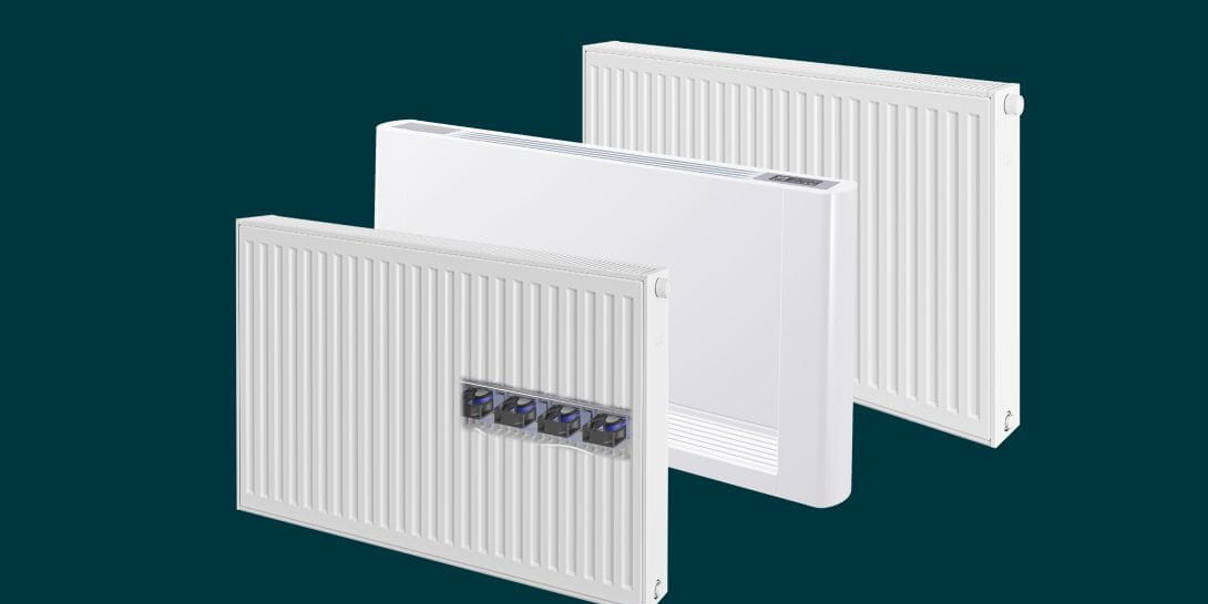
When it comes to designing or updating any HVAC system, choosing the right emitters is key to achieving comfort as well as efficiency, and creating a solution that perfectly suits the available space. In the case of a hydronic heating system, panel radiators, fan-assisted radiators and fan coil units are popular options that are often considered. Each of these offers distinct benefits in terms of performance, efficiency and flexibility, which makes them suitable for different environments and user needs. In this article, we compare these devices and look at their pros and cons.
- Rads and Towel Warmers
- Fan Convectors
- Low temperature heating
- Insights
1. Panel radiators
How they operate
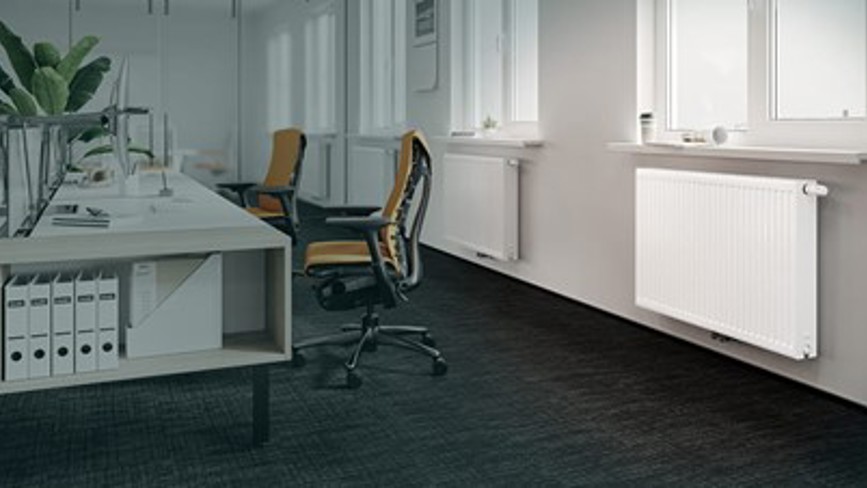
Panel radiators have improved considerably in recent decades. Technological advances and innovative product design ensure that modern panel radiators operate more efficiently. The way they heat rooms, however, remains the same, with a mixture of about 65% convection heat and 35% radiant heat (depending on the surface area ratio of water channels to convector fin). Panel radiators are suitable for system temperatures from 90°C to 45°C. This makes them compatible with regular boilers as well as condensing boilers and heat pumps. The efficiency of panel radiators can be upgraded by fitting thermostatic radiator valves (TRVs) or smart controls such the Unisenza Plus electronic thermostatic head (ETH).
Product benefits
Classic design: Available as a standard profile panel, or with a factory-fitted flat front panel or flat front panel embossed with fine lines, panel radiators have a classic design that’s easy to integrate in a variety of interiors. It’s also possible to order our premium panel radiators in over 70 different colours or choose from a range of horizontal and vertical designer radiators.
Silent operation: because panel radiators rely on natural convection, there is no noise, provided the system is balanced correctly.
Cost-effective: they are generally less expensive than more complex systems.
Variety of sizes: panel radiators are available in a huge variety of sizes, making them particularly suitable for replacing old radiators, but also for new builds.
Points to consider
Gradual heat distribution: because they rely on natural radiation and convection, panel radiators may take longer to warm a room compared to fan-assisted options.
Space considerations: panel radiators are wall-mounted, which can create limitations in some rooms. In low temperature heating systems, you may need larger panel radiators to ensure the heat demand can be met. Vertical radiators are a great solution where wall space is limited.
Best applications
Modern panel radiators are great for private homes and residential buildings, where a cost-effective solution is often sought. And, because there is such a great variety available, commercial buildings, offices and schools can also easily be equipped with panel radiators that suit their needs. For maximum safety in healthcare and educational facilities, our hygienic LST radiators fully comply with NHS Estates Guidance Notes 1998.
2. Fan-assisted radiators
How they operate
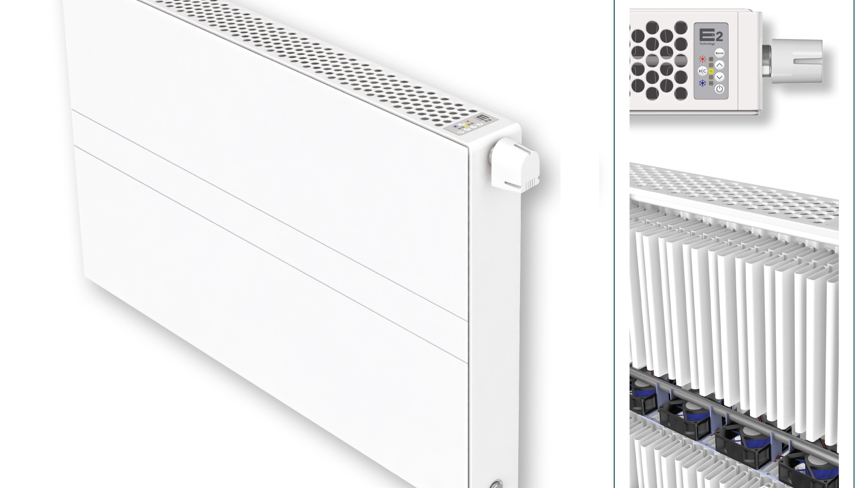
Fan-assisted radiators operate similarly to traditional panel radiators, but they are equipped with integrated fans. The fans support the convective heat and help to circulate the warm air more quickly, allowing the room to heat up faster. The fans on our Ulow E2 fan-assisted radiators switch on at a return temperature of 28°C, which increases convection and creates heat output up to 60% higher than a standard radiator. Thanks to this feature, fan-assisted radiators are perfect for low temperature heating systems.
Not only is Ulow E2 equipped with a boost mode to help to reach the desired temperature in the shortest possible time, it also has a dry cooling function that creates a pleasant summer breeze in combination with a reversible heat pump.
Product benefits
Faster heat distribution: the fan enables quicker and more efficient heating, ideal for larger rooms or low temperature heating systems.
Improved airflow: fan-assisted radiators move air more effectively, eliminating cold spots in the room.
Compact size: because the fans boost the heat output and create up to 60% more heat, fan-assisted radiators can be sized smaller than traditional panel radiators. This makes them a good option for rooms with limited space, or in renovation projects where the system temperatures drop and old radiators need to be replaced.
Points to consider
Sound: the addition of fans mean this type of radiator can generate a level of noise, which might be a concern in quiet environments. However, through smart product design we try to limit this. When Ulow E2 is in boost mode it reaches up to 34dB, comparable to the sound of someone whispering.
Power connection required: the fans require electricity which means a power supply must be available nearby (fused spur).
Best applications
Because they deliver heat more effectively compared to standard panel radiators, fan-assisted radiators are ideal for medium to large rooms where quicker and more efficient heat distribution is important. They are perfect where low temperature heating is preferred and especially for systems powered by heat pumps.
Finally, Ulow E2 has middle, left and right connection options so they are a great choice for renovation projects, as older panel radiators can be replaced without much construction work. In one fell swoop, you can reduce the system temperatures and create a future-proof HVAC system with the latest generation of radiators.
3. Fan coil units

How they operate
Contrary to panel radiators, fan coil units can use both hot and cold water. Hot or chilled water flows through the heat exchanger (coil), and an integrated electric fan blows air over the coil to distribute the conditioned air throughout the room. This set-up helps to create a higher heat output at lower system temperatures, and allows users to enjoy heating and cooling from the same device for year-round indoor climate comfort.
A fan coil unit such as iVector S2 works well with condensing boilers, but also perfectly combines with a heat pump in a low temperature heating system. The combination of low water content and an axial fan allows the fan coil unit to respond more quickly to fluctuations in room temperature.
Our fan coil unit is equipped with an integrated control unit that allows for easy temperature control and mode adjustment. Because the fan coil unit can be installed not only on or in the wall, but also on or in the ceiling, there is also an optional remote control which offers the same functionalities.
Product benefits
Dual functionality: fan coil units can be used for heating as well as active cooling, making them more versatile than standard panel radiators.
Precise temperature control: the axial fan and integrated thermostat allows more precise control of the room temperature.
Energy-efficient: fan coil units provide high outputs at low system temperatures offering great energy-efficiency, especially in large buildings or zoned areas.
Installation flexibility: units can be floor standing, wall mounted, ceiling mounted, or even fully recessed in the wall or ceiling, offering great flexibility for interior design and freeing up wall space.
Points to consider
Installation: fan coil units often require more extensive installation and need a power supply to run the fan. A condensate drain is also required for the active cooling function. To facilitate the installation of the iVector S2 as much as possible, we provide a clear installation guide and offer matching accessories , see our fan convectors brochure for full details.
Air movement & maintenance: the fan coil uses a higher degree of convection compared to a panel radiator so there is potentially more movement of air particles. Regular cleaning of the fan and heat exchanger is recommended to maintain efficiency and performance, otherwise dust and debris can accumulate in the unit leading to reduced airflow and potential issues with air quality.
Sound: like fan-assisted radiators, fan coil units produce sound from the fan, which may be an issue in certain environments. In boost mode the iVector S2 produces up to 57dB, which is comparable to moderate rainfall.
Higher cost: fan coil units tend to be more expensive than panel and fan-assisted radiators. Similarly, they consume extra energy to run the fan. However, because a fan convector generates such a high output at low system temperatures, it creates a more efficient system if it’s combined with an air-to-water heat pump. We therefore recommend to consider the complete picture instead of only the individual emitters.
Best applications
While fan coil units like the iVector S2 are a popular choice for use in commercial buildings such as offices and hotels, they are also ideal for schools, retail and other commercial premises, where both heating and cooling are needed. Fan coil units are also being installed more frequently in private homes. The iVector S2 can be used in new build projects as well as in heating renovation.
To further substantiate our comparison, we ran a simulation with two of our panel radiators ( Compact type 22 and 33), our Ulow-E2 , and our iVector S2 fan coil unit. We dimensioned each unit for a heat demand of 1500W in a 30m2 room and system temperatures of 45/35/20°C.
Compact Type 33 | Compact Type 22 | Ulow E2 | iVector S2 (VS11) | |
Height (mm) | 600 | 600 | 900 | 579 |
Width (mm) | 2200 | 3000 | 1800 | 1135 |
Depth (mm) | 166 | 105 | 107 | 129 |
Power (W) | 1,553 | 1,465 | 1,458 | 1,880 |
Speed | - | - | Medium | Medium |
m³ | 0.219 | 0.189 | 0.173 | 0.085 |
m² (wall space) | 1.320 | 1.800 | 1.620 | 0.657 |
Sound (dB) | - | - | 25 | 34 |
Power consumption (W) | - | - | 12 | 11 |
Water flow [l/h] | 133 | 126 | 125 | 163.5 |
The results of our simulation clearly demonstrate some of the points we mentioned above.
devices equipped with a fan (Ulow-E2 and iVector S2) take up less wall space than a classic type 22 radiator to deliver a comparable output. This can be very convenient in rooms with limited wall space. On the other hand, the panel radiators don’t produce sound and there is no additional power consumption to run any fans.
iVector S2 gives significantly higher output, which means it is possible to reduce the flow temperature even further to 40/32/20°C. In that case the power output becomes 1490W, which corresponds to the demand in our simulation. This clearly shows the iVector’s optimal compatibility with low temperature heating systems and its ability to generate the highest output while taking up the least wall space.
Another striking element in the simulation is the water flow. Clearly higher for the fan coil unit compared to the other emitters, it’s a feature that affects the sizing of the pipework, so it is important to take into account when designing the HVAC system. If the pipes are undersized, the water flow to the fan coil unit will be insufficient, causing the output to be lower than required.
Comparing panel radiators, fan-assisted radiators and fan coil units
To clearly highlight the similarities and differences between the 3 emitter types, we have combined our products in a comparative table.
Compact steel panel radiator | Ulow-E2 fan-assisted radiator | iVector S2 fan convector | ||
|---|---|---|---|---|
Installation | wall | + | ++ | ++ |
ceiling | - | - | ++ | |
Operation | passive heating/cooling | +/- | +/+ | -/- |
active heating /cooling | -/- | +/- | +/+ | |
Fan support | - | + | + | |
Fan speed | - | ++ | ++ | |
Max operating temperature | 110°C | 60°C | 80°C | |
Compatible heat sources | boiler | + | - | + |
condensing boiler | + | + | + | |
heat pump | + | + | + | |
chiller | - | - | + | |
Sound power | comfort | - | 20 dB | 24 dB |
boost | - | 36 dB | 47 dB | |
Power supply | 230 V / 50Hz | |||
Control | integrated /external | - / - | + / + | + / + |
Maintenance | + | ++ | +++ | |
Cost of ownership | £ | ££ | £££ | |
Final thoughts
When deciding between panel radiators, fan-assisted radiators and fan coil units, it’s important to realise you cannot compare them directly 1-to-1. Although they are all designed to create indoor climate comfort, each type of emitter has its own unique features, and pros and cons. Panel radiators are an excellent choice for simple, cost-effective heating in residential settings, as well as schools, offices, hospitals, etc. Fan-assisted radiators provide a higher output and offer a great solution to create a low temperature heating system in new build as well as renovation projects. Fan coil units, with their ability to both heat and cool at low temperatures, offer flexibility and precision, ideal for commercial spaces or homes requiring year-round climate control.
Our goal is to help our customers make an informed decision that ensures comfort and efficiency. With a diverse range of heating and cooling solutions, Myson is a one-stop-shop for a wide variety of products and systems that cover a variety of applications.
If you have any questions, please feel free to get in touch.